Expandedvocabularyitis

In any language there are words that must be mastered so as not to appear Johny Very Foreigner or a complete sack of potatoes: cat, thank you, eat etc; there are words that, correctly used, show an interest in the language or a “bottom caning and gym teacher who later in life gets arrested for liking small boys just a little too much” education: facetious, paradox, penultimate; then comes an almost inexhaustible amount of delicious-sounding words, the judicious use of which sets one aside from hoi-polloi: peradventure, nidificate, ataraxia.

There is, in my mind, one further category of words, of which the word “floccinaucinihilipilification” belongs. Whilst I may not know what an ereption is, or be unsure if a comment about my napiform head should elicit a coy smile or a broken bottle in the groin, these words have at least in their favour that I can write/pronounce them.

I could possibly get away unscathed by throwing the occasional “lippitude” or “hebetate” in my quotidian conversations (or, for that matter, “quotidian”), but I’d most likely be calling for an ambulance at the mere mumbled mention of the sesquipedian “floccinaucinihilipilification”.

I spend a fair amount of time browsing dictionaries and the like, finding what I consider to be interesting words to learn for my own pleasure, but I’ll be damned if I’m going to waste much-needed brenergy (that’s not a word, I just needed something that sounded a bit less childlike than brain energy) on something that will lead to either pain or cause others to think I’m an arrogant toss-brush.

Sesquipedaliophobia, by the way, is the fear of long words. Thinking this to be a joke I delved around a bit, and found out that it seems to be an accepted word. The ironical word for this fear is hippopotomonstrosesquipedaliophobia.

What The ¤*§ü

I’ve been interested in computers for more than a couple of weeks now, and even get to use the occasional “personal computer” in my day-to-day life. One thing I have newly discovered about this whole crazy IT thing: with so many unnecessary keys on the word-input device, or keyboard (I’m thinking “¤” and “e” in particular), why is there no ™ nor ® key?

It does not feature, truth be told, high on my list of things I wish I knew how to do – I’ve just realised why I used the preterite form, “knew”, and it’s thanks to Johanna (explanation of this eureka moment coming in a future entry) – though it appeals to the secret sciolist in me.

So, a call to computer people and, specifically, keyboard manufacturers across the globe: make the ™ and ® signs a permanent feature on future keyboards, because then I could do cool things like write “F®eya” or “a™osphere”. It’s all about kudos, folks.

Mini Mission To Haga

We decided to go on a mini-mission this afternoon, on the spur of the moment, and ended up at Fjärilshuset, just north of Stockholm.

There were a fair number of people, most of them in the restaurant, it seemed, which was to our advantage. I wouldn’t say we roamed leisurely (Freya was far too excited, particularly at the various pieces of fruit that had been placed in the frogs’ and snails’ aquariums), but we could roam most of the time unhindered by human traffic.

As nice as the park was, I couldn’t help but feel disappointed at the lack of actual butterflies. We spotted many koi, but, as nice as they may be to look at, that wasn’t the reason for paying 160kr entrance fee. I suppose, in fairness, we came out of season (I’m supposing butterflies have mating seasons in rainforest climes, don’t they?). If not then they need to do some serious rethinking or illegal importing.

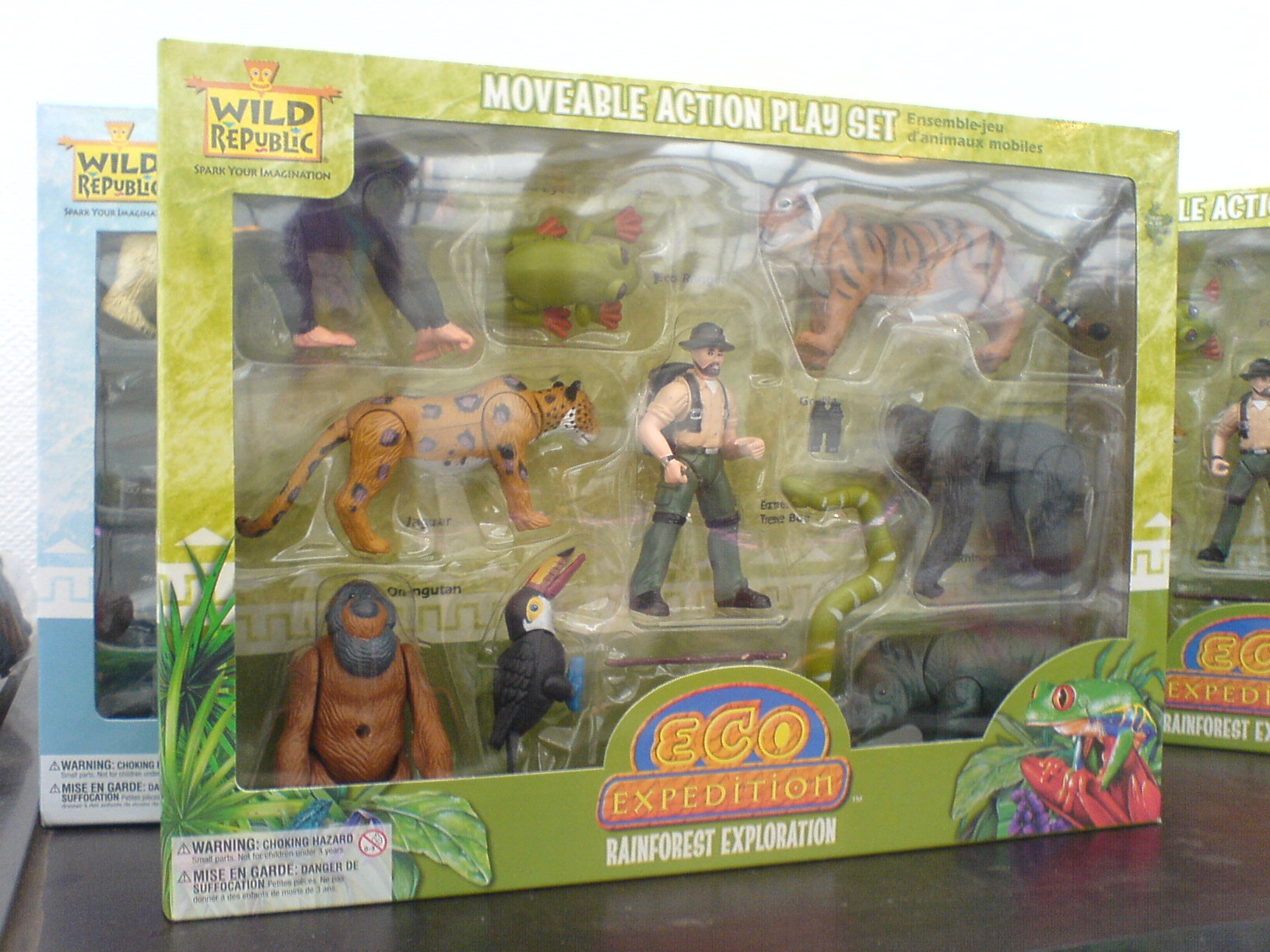
The gift shop seemed geared towards receiving a fair number of visitors. I was mightily impressed by the range of rubbish merchandise and embalmed scorpion lollipops on offer (no batteries though, of course), but my eye was caught by the aptly named “Eco Expedition ™ Rainforest Exploration” toy-pack (see photo). Indiana Jones (whoops, it’s obviously not him) is out in the jungle, with his reasonably well-scaled binoculars, when he comes across a fuck-off huge frog. Not quite sure why Wild Republic bothered making the animal swallow-safe when Indy’s (there I go again, tut!) looking device is a certainty for death by choking. Maybe it’s because there exists such things as scorpion lollipops, and a lime-green and orange amphibian looks far too enticing to be given a reasonable scale.

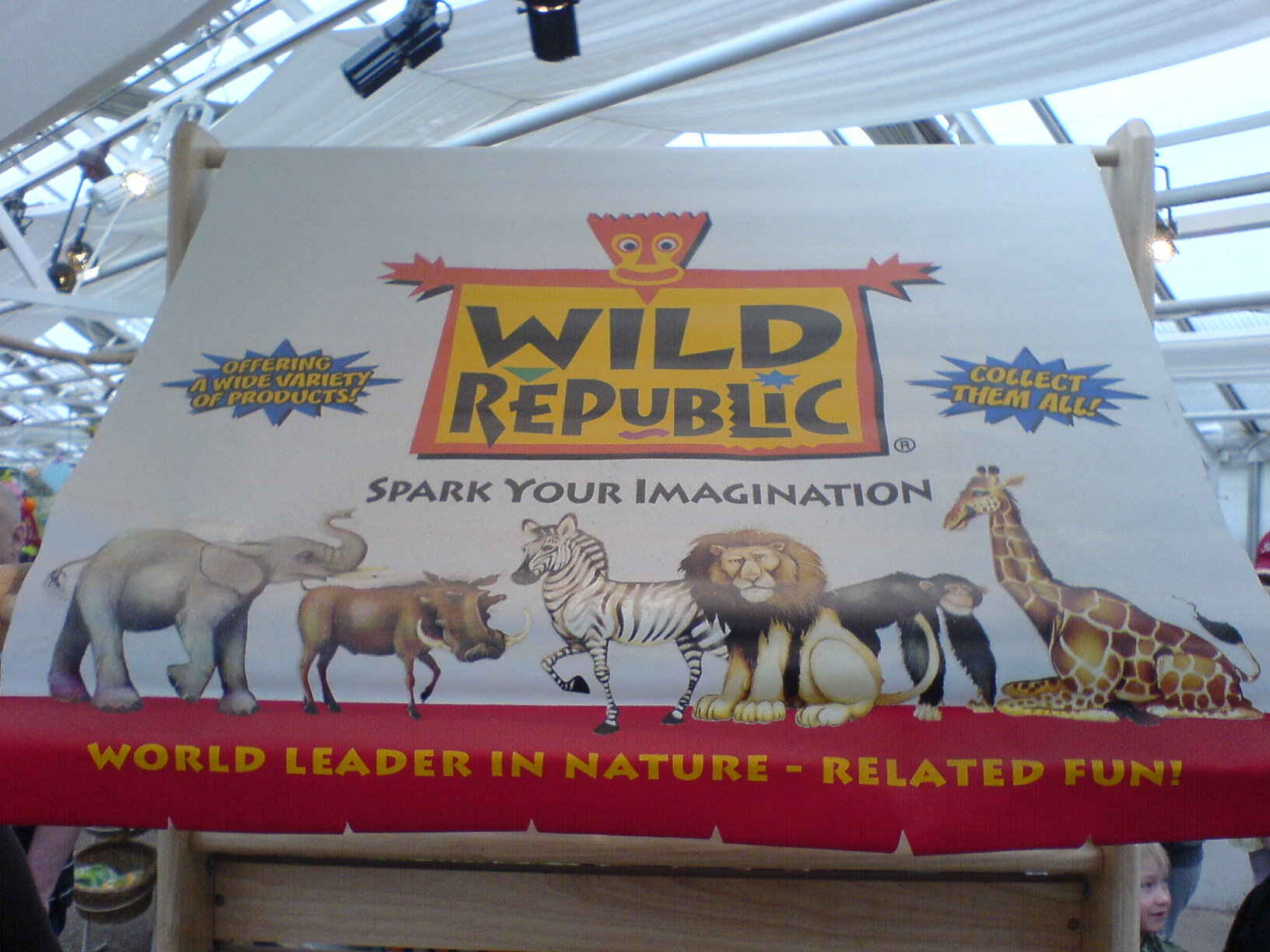
Not far from the exit of the gift shop, just above eye level where most people would not ever bother to look, is a dusty advert for that (now) well-known company, Wild Republic. I’ll skip any scale-related errors here, to point out what I consider to be one of the nattiest slogans I’ve come across this year: World Leader In Nature-Related Fun. I reckon if I have to explain further the wonder of this little gem, then it’s not worth knowing why. I will point out, though, they are (self-claimed) world leaders. Where the statistics are for nature-related fun contenders is anyone’s guess, but if Wild Republic say so, who am I to argue.

And to end on an educational note, which all my entries do, we come to the notion that the word “butterfly” was originally “flutterby”. I have always reckoned this to by a sack of dogs cocks, so far-fetched as to be beyond risible, and into the realms of, well, a sack of dogs cocks. Extensive research (i.e. Wikipedia and browsing the first few results of googling “butterfly etymology”) seems back up my dogs cocks theory, though I did find out that:

a) butterflies do not poo.

b) caterpillar poo is called frass.

c) Sign language for the word butterfly involves interlocking thumbs, flapping flat hands like wings.

Playing Videogames May Decrease Your Time Spent Reading

One of the small pleasures in life is flicking through the adverts that regularly appear in our postbox. Most of all I look forward to the newspaper-format electrical goods chainstore ads, of which there are a number.

It was during one such instance of paper perusal a few days ago that I chanced upon a page dedicated to the next generation of games consoles, the Wii, PS3 and XBox 360.

The PS3 was at the top of the page, despite (or, perhaps, because of) its higher cost and low sales figures. Although I have no plans to buy a PS3 (the XBox would be my inclination for a second system), I read the accompanying blurb, which, translated, went something thus:

The PS3 is a very powerful games machine. It has a powerful cell-processor that can be up to ten times more powerful than other processors. It has a powerful RSX graphic chip…“, blah, blah, blah.

The XBox 360, without a single adjective in its blurb, is 1000 crowns cheaper. This, in my mind, gives the word “powerful” a value of about 250 crowns (£20). I only hope this is the writing of a Sony fanboy madman, whose last task at work in the real world before being carted off to make small strips of metal out of larger strips of metal was to sell the PS3 to the ignorant public, one that is apparently swayed by the repetition of powerful adjectives.

And another thing, while I’m being facetious: making a statement that the PS3′s cell processors is “up to ten times more powerful than other processors” is irrelevant. Firstly, because no-one who plays videogames should seriously give a rats arse; secondly, I could write an advert about the N64, stating the same about its 93.75MHz processor (comparing it to, say, the first generation of games machines, for example); thirdly, I’ve forgotten.

So, if I were to take away the extraneous adjectival usage, along with any flimsy filler statements, the above PS3 blurb would go something like this:

The PS3 is a games machine. It has a cell-processor and an RSX graphic chip.

Were I really harsh, I’d take away the obvious words and any techno-babble that hints of trying to impress, leaving:

The PS3.

Sadly, not even a proper sentence, but I’ll allow such a grammatical faux-pas on this occasion. Still, such logical editing wouldn’t make my advertisement reading past-time as enjoyable, though I’d get through a hell of a lot more adverts.

Old Writings #2

Probably written about the same time as my previous literary find (around 1994), a short diatribe about religion found its way onto paper, thus preserving my hubristic ramblings forever. I still agree with a fair amount of what I wrote then, though there is also a great deal that oversimplifies the subject, and probably just as much that is wrong; however, regardless the validity of the text, I definitely come across as a supercilious pansophist, which fits perfectly with the erstwhile teenage/young adult Jon. Despite the arrogance of it all, here it is:

The main problem with Western religion is the tenet that we are born as sinners and that our only salvation is to repent, to give ourselves over, to a higher being.

Most of our anxieties, our fears, our inhibitions, are given to us in childhood, and this notion of eternal damnation through constant indoctrination reinforces our inadequacies as human beings.

The sooner we recognise the falacy of religion, the sooner we shake off this self-limiting ideology, then the sooner we can realise the inherent goodness that lies repressed at the very centre of each of us.

The real evil reveals itself when religious and political indoctrination is complete, when sexual, racial and gender bigotry, competitiveness and unemotional apathy are the norm, whilst harmony, co-operation and community responsibility are ill-conceived utopian ideas to be scorned.

It is time that each and every one of us realises the truth. Then, and only then, can we begin to repair the damage done, and remember: at the very base of our being we have had the potential to do incredible things for the Universe.

Realise this and we are at the beginning of true enlightenment.